Hampi Ruins Tour by Private Car - UNESCO Sites, Vijayanagara Empire & Complete Itinerary
Hampi Ruins Tour by Private Car – Exploring the Lost Capital of the Vijayanagara Empire
Few places in India create a sense of wonder quite like Hampi. Spread across a dramatic landscape of giant boulders, ancient temples, royal enclosures, sacred monuments, and archaeological treasures, Hampi is one of the most extraordinary historical destinations in Asia. Recognized as a UNESCO World Heritage Site, the region preserves the remains of the once-magnificent Vijayanagara Empire, which was among the wealthiest and most powerful kingdoms in the world during its peak.
Today, visitors arriving in Hampi encounter an open-air museum unlike any other. Massive temple complexes emerge from rocky hillsides. Stone chariots stand silently in temple courtyards. Ancient marketplaces stretch across vast landscapes. Royal structures, military installations, ceremonial platforms, and water systems reveal the sophistication of a civilization that flourished centuries ago.
A Hampi private car tour is one of the most practical and rewarding ways to explore this remarkable destination. Unlike compact heritage cities where attractions are concentrated in a small area, Hampi covers an extensive region. The major sites are scattered across different zones, often separated by several kilometers. Private transportation allows travelers to move comfortably between monuments while maximizing sightseeing opportunities.
The landscape itself contributes significantly to Hampi's appeal. Enormous granite boulders create surreal scenery that appears almost otherworldly. The combination of natural beauty and architectural heritage gives the region a unique identity that sets it apart from every other historical destination in India.
History enthusiasts, photographers, architecture lovers, cultural travelers, and adventure seekers all find something compelling in Hampi. Every monument tells a story about political power, artistic achievement, religious devotion, and economic prosperity. Exploring the ruins becomes more than a sightseeing experience; it becomes a journey through one of the most fascinating chapters in Indian history.
For travelers seeking a destination that combines spectacular landscapes with extraordinary heritage, few places rival the experience of a Hampi sightseeing tour by private car.
Explore the Ancient Wonders of Hampi
Discover the magnificent ruins of Hampi with a private car and experienced driver. Visit ancient temples, royal monuments, stone chariots, and breathtaking landscapes while enjoying a comfortable journey tailored to your travel schedule.
Understanding the Rise and Glory of the Vijayanagara Empire
To fully appreciate Hampi, it is essential to understand the remarkable story of the Vijayanagara Empire, which transformed this region into one of the greatest cities of its time. Founded during the fourteenth century, the empire rapidly emerged as a dominant political and economic force in South India.
At its height, Vijayanagara controlled vast territories, maintained extensive trade networks, supported thriving cultural institutions, and attracted merchants from across Asia, the Middle East, and Europe. Historical accounts describe a city of extraordinary wealth where bustling markets offered precious gems, spices, textiles, horses, and luxury goods.
The rulers of Vijayanagara invested heavily in architecture, religion, infrastructure, and military defense. The result was a capital city filled with monumental temples, royal residences, public buildings, irrigation systems, and fortified structures. Much of what visitors see today represents the surviving remains of this once-thriving metropolis.
Foreign travelers who visited the city during its golden age recorded detailed descriptions of its size, prosperity, and beauty. Their accounts portray a sophisticated urban center that rivaled many of the world's greatest cities. Wide avenues, impressive marketplaces, ceremonial spaces, and architectural masterpieces reflected the empire's immense resources and ambition.
The city's decline followed a major military defeat that led to widespread destruction. Although the empire itself eventually faded from prominence, the monumental ruins survived. Centuries later, archaeologists, historians, and conservationists began documenting and preserving the site, allowing future generations to appreciate its significance.
A Hampi heritage tour provides opportunities to explore physical evidence of this remarkable civilization. Temple complexes, royal structures, audience halls, military installations, and water management systems all reveal the sophistication of Vijayanagara society.
Understanding the empire's history transforms the ruins from isolated monuments into interconnected elements of a larger story. Visitors begin to see how political authority, economic power, religious devotion, and artistic achievement combined to create one of India's greatest historical civilizations.
Today, the surviving remains stand as a powerful reminder of what once existed here. Walking through Hampi allows travelers to imagine a vibrant city that played a central role in shaping the history of South India.
Virupaksha Temple – The Living Heart of Hampi
Among all the monuments in Hampi, Virupaksha Temple occupies a unique position. Unlike many other historical structures that function primarily as archaeological sites, this temple remains an active place of worship and continues traditions that have endured for centuries.
Dedicated to Lord Shiva, the temple predates the Vijayanagara Empire and served as an important religious center long before the city's rise to prominence. As the empire expanded, rulers invested heavily in the temple's development, transforming it into one of the most significant religious institutions in the region.
The temple's towering gateway dominates the surrounding landscape and serves as one of Hampi's most recognizable landmarks. Visible from considerable distances, the structure immediately captures attention through its scale and intricate architectural details.
Visitors entering the temple complex encounter a series of courtyards, shrines, pillared halls, and sacred spaces that illustrate the sophistication of South Indian temple architecture. Detailed carvings depict mythological scenes, religious figures, animals, and decorative motifs that demonstrate exceptional artistic skill.
One of the most fascinating aspects of the temple is its continuous connection to local communities. Pilgrims, priests, and worshippers maintain a living spiritual tradition that links the present directly to the site's historical past. This ongoing religious activity creates an atmosphere distinct from purely archaeological monuments.
The temple also serves as an excellent starting point for a Hampi UNESCO tour because it introduces visitors to many of the themes that define the region: religion, architecture, cultural continuity, and historical significance.
Photography enthusiasts appreciate the interplay of light and shadow within the temple complex. Early morning and late afternoon visits are particularly rewarding because the changing sunlight enhances the texture and detail of the stonework.
Exploring Virupaksha Temple provides insight into the spiritual foundations of Vijayanagara society. The monument stands not only as an architectural masterpiece but also as a symbol of cultural resilience and continuity.
For many visitors, the temple becomes one of the most memorable stops during their journey through Hampi.
Vittala Temple and the Iconic Stone Chariot
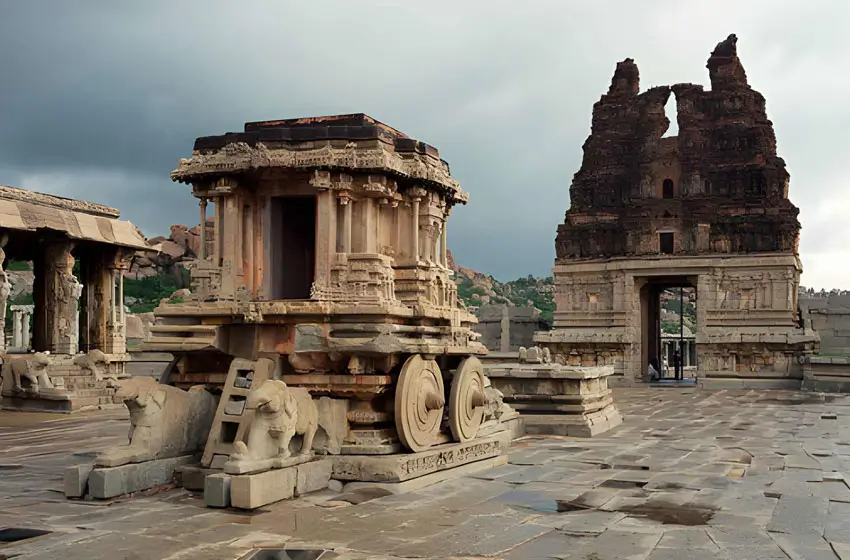
The Vittala Temple is widely regarded as the architectural highlight of Hampi and one of the finest examples of temple construction in India. Its reputation rests on extraordinary craftsmanship, innovative design, and the presence of one of the country's most famous monuments: the iconic stone chariot.
Located within a large temple complex, the stone chariot has become the visual symbol of Hampi. Carved with remarkable precision, it demonstrates the artistic mastery achieved during the Vijayanagara period. Although often referred to as a chariot, the structure actually functions as a shrine and reflects the empire's commitment to architectural excellence.
The surrounding temple complex is equally impressive. Intricately carved pillars, expansive courtyards, decorative halls, and detailed sculptures create an environment that rewards careful exploration. Every surface appears to contain another example of artistic ingenuity.
Among the temple's most celebrated features are the legendary musical pillars. These pillars became famous because of the sounds they were believed to produce when gently tapped. While preservation efforts now restrict direct interaction, the structures continue to attract fascination from visitors and researchers alike.
A private car tour of Hampi makes it easy to reach Vittala Temple and combine the visit with nearby attractions. Since the site occupies a substantial area, travelers often spend considerable time exploring its architectural details and learning about its historical significance.
The location also offers excellent opportunities for photography. The combination of monumental architecture, open landscapes, and dramatic lighting conditions creates countless possibilities for memorable images.
Beyond its visual appeal, Vittala Temple reflects the economic prosperity and cultural sophistication of the Vijayanagara Empire. The resources required to construct such a monument reveal the kingdom's wealth and organizational capabilities.
For many travelers, visiting Vittala Temple represents the highlight of their Hampi experience. The combination of artistic achievement, historical importance, and architectural beauty makes it one of India's most extraordinary heritage sites.
The Royal Enclosure and the Political Power of Vijayanagara
While temples dominate much of Hampi's landscape, the Royal Enclosure reveals another side of the empire: its political and administrative power. This extensive area once served as the center of royal authority and housed some of the most important governmental functions within the kingdom.
Today, visitors can explore the remains of audience halls, ceremonial platforms, residential complexes, water systems, and administrative structures that once supported the functioning of a vast empire. Although many buildings survive only as foundations and partial walls, the scale of the site remains impressive.
One of the most significant features is the Mahanavami Dibba, a large ceremonial platform used for royal celebrations, military parades, and public events. Standing atop the structure provides excellent views of the surrounding area while helping visitors appreciate the grandeur of imperial ceremonies.
Nearby attractions such as the Lotus Mahal and Elephant Stables further illustrate the diversity of architectural styles present within Hampi. These monuments demonstrate influences from multiple cultural traditions and reflect the cosmopolitan character of the Vijayanagara court.
The sophisticated water management systems found throughout the Royal Enclosure also deserve attention. Channels, tanks, reservoirs, and irrigation structures reveal advanced engineering capabilities that supported both urban life and agricultural production.
A Hampi archaeological tour often includes detailed exploration of this area because it provides crucial insight into how the empire functioned beyond its religious institutions.
Walking through the Royal Enclosure encourages visitors to imagine the political activity that once filled these spaces. Diplomats, military leaders, administrators, merchants, and royal officials would have gathered here to shape the future of one of India's most powerful kingdoms.
Understanding this aspect of Hampi helps create a more complete picture of the civilization that flourished here for centuries.
The Extraordinary Boulder Landscape That Makes Hampi Unique
One of the reasons Hampi feels so different from other historical destinations is its extraordinary natural setting. Massive granite boulders dominate the landscape, creating scenery that appears almost surreal.
These formations are not simply a backdrop to the monuments; they are an integral part of the Hampi experience. Temples, shrines, watchtowers, and pathways were often constructed in harmony with the surrounding terrain. Architects and builders used the natural landscape to enhance both functionality and aesthetics.
The boulder-strewn hills create dramatic viewpoints that reward exploration. Many visitors climb elevated areas to enjoy panoramic views of temple complexes, agricultural fields, river valleys, and distant monuments. The perspective gained from these locations helps illustrate the vast scale of the ancient city.
Photographers are particularly drawn to Hampi because of the visual contrast between natural formations and human-made structures. Sunrise and sunset often produce spectacular lighting conditions that transform the landscape into a photographer's paradise.
The Tungabhadra River further enhances the region's beauty. Flowing through the area, it provides scenic views, supports local agriculture, and contributes to the historical significance of the site.
A private car tour in Hampi allows travelers to access multiple viewpoints and explore different sections of the landscape without the physical demands associated with long-distance walking between attractions.
The geological uniqueness of Hampi adds another layer of fascination to the destination. Visitors are not only exploring historical ruins but also experiencing one of India's most distinctive natural environments.
Together, the monuments and landscapes create a destination unlike any other, where nature and history exist in remarkable harmony.
Discover Hampi at Your Own Pace
Make the most of your Hampi visit with a chauffeur-driven private car. Explore centuries-old temples, impressive archaeological sites, scenic viewpoints, and hidden gems without worrying about transportation or fixed schedules.
Suggested Hampi Itinerary by Private Car
A well-planned Hampi private sightseeing itinerary helps visitors maximize their time while ensuring that major attractions receive adequate attention.
The day often begins at Virupaksha Temple, where travelers can experience the spiritual atmosphere and explore one of Hampi's oldest active religious sites. Nearby markets and historic streets provide additional context regarding the city's cultural history.
The next section of the itinerary typically focuses on Vittala Temple and the famous stone chariot. Ample time should be allocated for photography and detailed exploration of the temple complex.
Later, visitors can explore the Royal Enclosure, including the Mahanavami Dibba, Lotus Mahal, Elephant Stables, and surrounding structures. These monuments reveal the administrative and ceremonial dimensions of Vijayanagara society.
Afternoon visits often include elevated viewpoints and scenic locations overlooking the boulder landscape. These stops provide opportunities to appreciate the scale and beauty of the region.
Additional attractions may include archaeological sites, riverside monuments, ancient gateways, and lesser-known temples scattered throughout the area.
Private transportation allows the itinerary to remain flexible, accommodating individual interests and energy levels. Some travelers focus primarily on architecture, while others prioritize photography, history, or landscape exploration.
The ability to customize the route ensures a more enjoyable and rewarding experience compared to rigid group tours.
Why a Private Car Is the Best Way to Explore Hampi
A private car tour of Hampi offers significant advantages because of the destination's size and layout. Major attractions are spread across a large area, making transportation an important factor in the overall experience.
Private vehicles provide comfort, flexibility, and efficiency. Travelers can move easily between sites, avoid unnecessary walking in extreme weather conditions, and adjust schedules according to personal interests.
Experienced drivers often possess valuable local knowledge regarding routes, viewpoints, timing, and lesser-known attractions. Their recommendations can significantly enhance the quality of the journey.
Families, photographers, senior travelers, and history enthusiasts particularly benefit from the convenience of private transportation. The ability to travel independently while maintaining a personalized itinerary improves both comfort and flexibility.
For visitors seeking a comprehensive understanding of one of India's greatest historical destinations, private transportation provides the ideal balance of convenience and freedom.
A thoughtfully organized Hampi UNESCO World Heritage tour by private car ensures that travelers can fully appreciate the extraordinary combination of history, architecture, archaeology, and natural beauty that defines this remarkable destination.